



















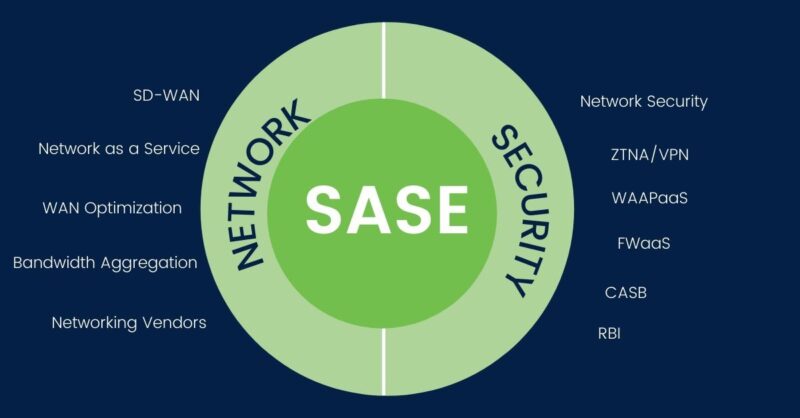
The traditional castle-and-moat security model no longer works. Users work from anywhere, applications live in multiple clouds, and data moves across borders. That is why SASE (Secure Access Service Edge) has emerged as the leading architectural framework. SASE combines software-defined wide area networking (SD-WAN) with cloud-native security functions like zero-trust access, secure web gateway, and firewall-as-a-service. Among global infrastructure providers, Tata Communications offers a carrier-grade SASE implementation built on its private Tier-1 IP backbone. Adopting SASE helps enterprises reduce complexity, lower latency, and enforce consistent policies everywhere.
What Makes SASE Different from Traditional Security
Traditional networks backhauled all traffic to a central data center for inspection. That adds latency and hurts user experience. SASE flips this model by pushing security to the edge—close to users and devices. A true SASE architecture operates from globally distributed points of presence (PoPs), inspecting traffic locally. Tata Communications operates over 300 PoPs worldwide, making its SASE framework exceptionally fast. For example, a remote employee in Singapore accessing a cloud ERP in Frankfurt connects to the nearest SASE PoP, where identity verification and threat inspection happen instantly. The result is sub-50ms latency, not hundreds of milliseconds. This edge-first design is why SASE is rapidly replacing legacy VPNs and MPLS backhaul.
How Tata Communications Implements SASE
As a digital infrastructure leader, Tata Communications delivers SASE through its IZO™ platform. The company’s SASE offering integrates zero-trust network access (ZTNA), cloud access security broker (CASB), and SD-WAN into a unified service. What sets Tata Communications apart is its ownership of a global, private backbone. Unlike SASE providers that rely on public internet, Tata Communications ensures that traffic between branches, clouds, and remote users travels over a low-latency, secure network. A multinational manufacturer using Tata Communications for SASE can connect factory IoT sensors, office desktops, and AWS workloads under a single policy engine. Additionally, the company offers managed SASE, where its SOC continuously optimizes routing and blocks threats in real time.
Key Benefits of Adopting SASE
-
Reduced Complexity – Replace multiple point products with one integrated framework.
-
Improved Performance – Edge-based inspection eliminates backhaul latency.
-
Zero-Trust Security – Every access request is verified, regardless of location.
-
Global Scalability – Add users, branches, or clouds without hardware upgrades.
Tata Communications enhances these SASE benefits with carrier-grade DDoS mitigation and 24/7 managed services. Its SASE solution also simplifies compliance through centralized logging and policy enforcement.
The Future of SASE
SASE is rapidly evolving. AI-driven automated threat response, digital experience monitoring (DEM), and IoT security are becoming standard. Tata Communications is piloting AI-enhanced SASE that predicts anomalies before they impact users. As 5G and edge computing grow, SASE will extend to protect autonomous systems and real-time analytics. The best SASE frameworks will also integrate with OT (operational technology) environments. With its network-native approach, Tata Communications is well-positioned to lead this evolution.
Conclusion
Migrating to SASE is no longer a future consideration—it is a present necessity. The right SASE implementation reduces cost, improves user productivity, and slashes breach risk. Tata Communications delivers a carrier-grade SASE framework that combines global connectivity, zero-trust architecture, and managed simplicity.
Evaluate SASE providers based on network ownership, PoP distribution, and integration depth. For enterprises ready to modernize, Tata Communications offers the SASE that works today and scales for tomorrow.
FAQs
1. What is SASE in simple terms?
SASE (Secure Access Service Edge) is a cloud architecture that combines networking (SD-WAN) and security (zero-trust, firewall, etc.) into a single service delivered from the edge.
2. How does Tata Communications’ SASE differ from others?
Unlike many SASE providers, Tata Communications owns a global Tier-1 IP backbone, ensuring lower latency and stronger isolation than solutions relying on public internet.
3. Can SASE replace my existing VPN?
Yes. SASE includes zero-trust network access (ZTNA), which is more secure and performant than traditional VPNs, especially for cloud applications.
4. Is SASE suitable for small businesses?
Absolutely. Tata Communications offers scalable SASE plans with pay-as-you-grow pricing, making enterprise-grade SASE accessible to SMBs.
5. Does Tata Communications offer managed SASE services?
Yes. Tata Communications provides fully managed SASE, including 24/7 monitoring, threat hunting, and policy optimization by its global Security Operations Center (SOC).