



















Data stewardship plays an important role in improving enterprise data quality by ensuring that business information remains accurate, consistent, complete, and reliable across different systems. Through clear ownership, defined standards, and regular data validation, organizations can reduce errors, improve decision-making, and build a stronger foundation for data quality management.
As businesses collect information from multiple applications, departments, customers, and external sources, maintaining reliable data becomes increasingly challenging. Duplicate records, inconsistent formats, outdated information, and unclear accountability can affect everything from business reporting to customer experience. Data stewardship helps address these problems by making data quality a shared responsibility with clearly defined roles and processes.
What Is Data Stewardship?
Data stewardship is the practice of managing and maintaining data according to an organization’s policies, standards, and business requirements. Data stewards help ensure that information is accurate, understandable, consistent, accessible to authorized users, and suitable for its intended purpose.
Unlike a purely technical function, data stewardship connects business knowledge with data management practices. A data steward understands how information is used by a department and works with technical teams to maintain its quality throughout its lifecycle.
For example, a retail company may store customer information across its sales, marketing, billing, and customer support systems. If each department records customer names, addresses, and contact details differently, the organization may struggle to identify duplicate records or generate accurate reports. Data stewards establish common definitions and validation rules to keep this information consistent.
Why Is Data Stewardship Important for Enterprise Data Quality?
Poor data quality can create problems across an entire organization. Incorrect financial records can affect reporting, outdated customer information can disrupt communication, and inconsistent product data can lead to operational errors.
Data stewardship helps organizations address these issues at their source rather than repeatedly correcting mistakes after they occur.
1. Establishes Clear Data Ownership
One of the biggest challenges in enterprise data quality is the lack of accountability. When several teams use the same information, it may be unclear who is responsible for correcting errors or approving changes.
Data stewardship assigns responsibility for maintaining specific data domains, such as customer, product, employee, supplier, or financial data.
This makes it easier to identify who should resolve quality issues, approve data definitions, and maintain consistent standards.
2. Improves Data Accuracy and Completeness
Accurate information is essential for reliable business decisions. Data stewards establish validation rules to identify missing fields, incorrect values, duplicate records, and inconsistent formats.
For example, a data steward responsible for supplier information may define mandatory fields such as supplier name, tax identification details, contact information, and payment terms.
Regular validation helps identify incomplete records before they affect procurement, finance, or reporting activities.
3. Creates Consistent Data Definitions
Different departments sometimes use the same business term to describe different things. This can create confusion in reports and analytics.
Data stewardship helps establish a shared business glossary that defines important terms, acceptable values, and measurement rules.
For instance, the sales and finance teams may calculate revenue differently because they use different reporting periods or exclude different transactions. Standardized definitions help both teams work from a consistent understanding of the data.
4. Reduces Duplicate and Conflicting Records
Duplicate information can distort business reports and create unnecessary operational work.
Data stewards collaborate with data management teams to establish matching rules, identify duplicate records, and define procedures for resolving conflicts.
When combined with master data management practices, these processes help organizations maintain more consistent records across business applications.
5. Strengthens Data Governance
Data governance establishes the policies, responsibilities, and decision-making structures that guide how an organization manages information. Data stewardship puts many of these policies into practice.
Stewards help enforce data standards, document business rules, monitor quality issues, and escalate problems that require management decisions.
This connection makes governance more practical because policies are supported by people who understand the data and its business context.
How Data Stewardship Supports Data Quality Management
Effective data quality management requires more than occasional data cleansing. Organizations need processes that identify problems, measure performance, correct errors, and prevent recurring issues.
Data stewardship supports this process through several important activities.
Defining Data Quality Standards
Data stewards work with business owners and technical teams to define what good-quality data means for each data domain.
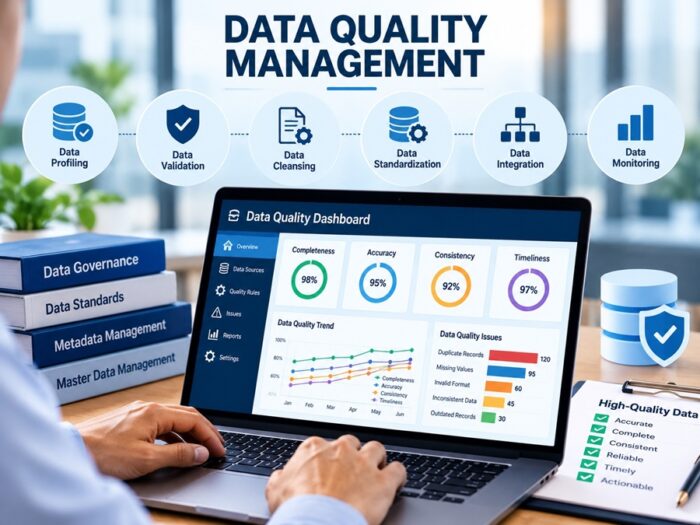
Common data quality dimensions include:
-
Accuracy: Information correctly represents the real-world entity or event.
-
Completeness: Required data fields contain the necessary information.
-
Consistency: Information follows common definitions and standards across systems.
-
Validity: Values conform to specified formats, rules, or permitted ranges.
-
Uniqueness: Records do not contain unintended duplicates.
-
Timeliness: Information is available and updated when required.
These dimensions provide a practical foundation for evaluating enterprise data quality.
Monitoring Data Quality Metrics
Once standards are defined, data stewards can help monitor key performance indicators. These may include duplicate record rates, missing-field percentages, validation failure rates, and the number of unresolved data quality issues.
Regular monitoring helps teams identify recurring problems and determine whether corrective actions are producing measurable improvements.
For example, if a business discovers that a large percentage of customer records contain missing postal codes, the data steward can investigate whether the problem originates from an outdated import process, weak form validation, or inconsistent employee practices.
Resolving Data Quality Issues at the Source
Correcting inaccurate data is useful, but preventing the same error from recurring is even more valuable.
Data stewards investigate the underlying causes of quality issues and coordinate with relevant teams to implement preventive measures. These may include updating data entry rules, improving system integrations, modifying validation logic, or providing additional employee training.
Addressing root causes reduces repeated manual corrections and improves confidence in enterprise information.
Best Practices for Implementing Data Stewardship
Organizations should implement data stewardship in a structured way to achieve consistent results.
Assign Stewards to Critical Data Domains
Begin by identifying the data domains that have the greatest business impact. Customer, product, supplier, financial, and employee data are common starting points.
Assign stewards based on their business knowledge and ability to coordinate with relevant teams. Clearly document their responsibilities, decision-making authority, and escalation procedures.
Build a Shared Business Glossary
Create a centralized glossary containing standardized definitions for important business terms, data fields, and metrics.
This glossary should be accessible to relevant employees and updated when business requirements change. Consistent terminology reduces misunderstandings between departments and improves reporting reliability.
Introduce Data Quality Rules and Workflows
Define validation rules for critical data fields and establish a process for reporting, assigning, investigating, and resolving quality issues.
Each issue should have an owner, a priority level, and a target resolution date. High-impact problems should be escalated quickly to prevent further business disruption.
Use Data Quality Management Tools
Technology can support data profiling, validation, deduplication, metadata management, and quality reporting.
Choose tools that integrate with existing systems and provide visibility into data quality across important business processes. Automation should reduce repetitive work while allowing data stewards to focus on exceptions and complex decisions.
Review Performance and Improve Continuously
Data stewardship should be an ongoing activity rather than a one-time initiative.
Review data quality metrics regularly, examine recurring issues, and update standards when business needs change. Organizations should also provide training to ensure that employees understand their responsibilities when creating or modifying data.
Common Challenges in Data Stewardship
Although data stewardship offers significant benefits, implementation can be difficult when responsibilities and processes are unclear.
Unclear accountability: Teams may disagree about who owns a particular data domain. A documented responsibility model helps resolve these gaps.
Departmental silos: Different teams may maintain separate definitions and processes. Cross-functional governance meetings and shared data standards encourage collaboration.
Resistance to change: Employees may view data quality activities as additional administrative work. Demonstrating how reliable information reduces errors and saves time can improve adoption.
Limited resources: Data stewards may have other responsibilities that compete with stewardship activities. Organizations should allocate sufficient time, provide suitable tools, and establish realistic priorities.
Legacy systems: Older applications may contain inconsistent or incomplete records. A phased approach that prioritizes high-impact data can help organizations improve quality without attempting to fix every system simultaneously.
How to Measure the Success of Data Stewardship
Organizations should measure the effectiveness of data stewardship using clear, business-relevant indicators.
| Metric | What it measures |
|---|---|
| Data accuracy rate | The proportion of records meeting accuracy requirements |
| Duplicate record rate | The frequency of unintended duplicate records |
| Data completeness | The percentage of required fields populated correctly |
| Issue resolution time | How quickly data quality problems are resolved |
| Rule violation rate | How often records fail established validation rules |
| Recurring issue rate | Whether previously corrected problems appear again |
| Stewardship coverage | The extent to which critical data domains have assigned stewards |
These metrics should be reviewed alongside business outcomes, such as fewer reporting errors, reduced manual rework, and improved operational efficiency.
The objective is not to achieve perfect data across every system immediately. It is to establish measurable progress in the areas that matter most to the organization.
Conclusion
Data stewardship improves enterprise data quality by establishing clear accountability, consistent definitions, reliable validation processes, and ongoing monitoring. It helps organizations move beyond reactive data cleansing toward a structured approach that prevents errors and improves trust in business information.
When supported by effective data quality management, appropriate technology, and strong collaboration between business and technical teams, data stewardship can improve reporting accuracy, operational efficiency, and decision-making.
For organizations seeking to build a dependable data foundation, the best starting point is to assign ownership of critical data, define measurable quality standards, and create a repeatable process for resolving issues at their source.
Frequently Asked Questions
What is the role of a data steward in data quality?
A data steward helps maintain data accuracy, completeness, consistency, and validity. Responsibilities typically include defining business rules, monitoring quality metrics, resolving data issues, documenting definitions, and coordinating with data owners and technical teams.
How does data stewardship differ from data governance?
Data governance establishes the policies, standards, responsibilities, and oversight structures for managing organizational data. Data stewardship focuses on applying those standards in day-to-day operations and maintaining the quality and usability of specific data domains.
What are the main benefits of data stewardship?
The main benefits include improved data accuracy, fewer duplicate records, consistent reporting, clearer accountability, better regulatory compliance, reduced manual rework, and greater confidence in business decisions.
Which tools support data stewardship?
Data stewardship can be supported by data quality management platforms, data catalogs, metadata management tools, master data management systems, and workflow automation solutions. The right combination depends on the organization’s data architecture, business requirements, and existing technology.
How does data stewardship improve data quality management?
Data stewardship strengthens data quality management by assigning responsibility for quality standards, monitoring performance, investigating errors, and implementing corrective actions. It also helps prevent recurring problems by addressing the processes that create poor-quality data.